


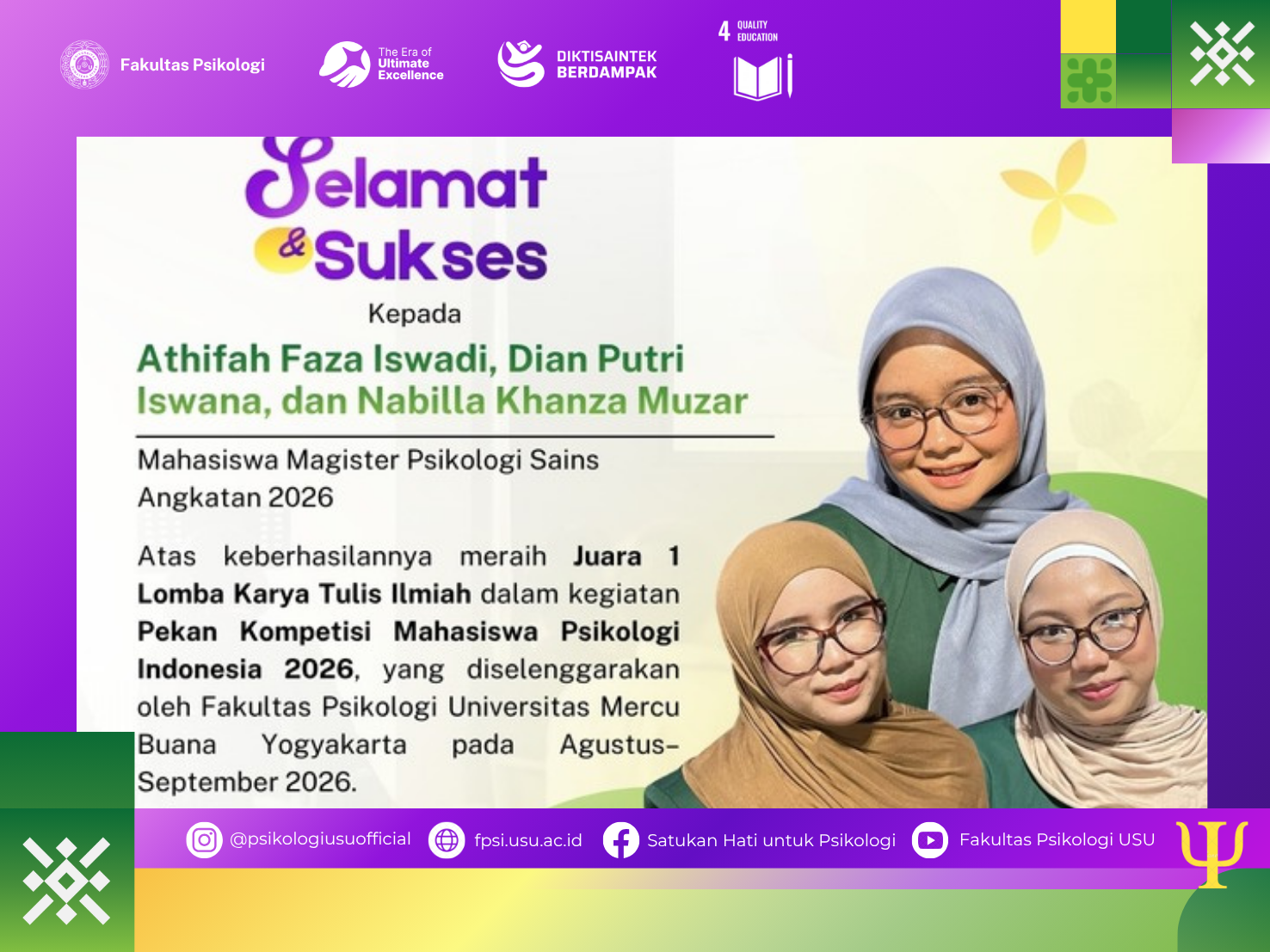
In the competition, the three students presented a scientific paper entitled “Different, Not Distant: Strengthening Sense of Belonging through an Inclusive Community to Improve the Psychological Well-Being of Persons with Disabilities.” The paper was developed in response to the theme provided by the organizers: “Weaving Diversity to Realize the Psychological Well-Being of Society.”
Their interest in diversity issues motivated the team to discuss the importance of building an inclusive environment for persons with disabilities. According to the team, persons with disabilities continue to face stigma and different treatment from the general public. These circumstances can affect their psychological well-being and opportunities to participate in social life.
Through their paper, the team emphasized that inclusion is not merely about providing access or opportunities for persons with disabilities to participate in community and educational activities. More importantly, inclusion must create an environment where every individual feels accepted and valued. They must also be involved and have equal opportunities to become part of a community.
As a solution to this issue, the team proposed an Inclusive Community model consisting of five stages: Access, Accept, Participate, Connect, and Belong. This model is designed to build an environment that does not merely provide space for persons with disabilities to be present, but also encourages the development of equal and meaningful social relationships.
The process begins with providing access (Access), followed by acceptance without discrimination (Accept) and active involvement in the community (Participate). The next stage encourages the development of positive social relationships (Connect), leading to a sense of ownership and belonging within the community (Belong). Through this approach, the team hopes that persons with disabilities can strengthen their sense of belonging and improve their psychological well-being.
The idea presented in this scientific paper is also in line with Sustainable Development Goal (SDG) 4, Quality Education. This goal emphasizes the importance of inclusive education that provides equal opportunities for everyone. This commitment is also reflected in efforts to create an educational environment that is welcoming to persons with disabilities. Thus, everyone has the opportunity to learn and develop their potential without experiencing discrimination.
This achievement demonstrates that students of the USU Faculty of Psychology are capable of producing scientific ideas relevant to social issues. From the perspective of psychological science, the paper is expected to raise public awareness of the importance of inclusion and acceptance of diversity. Differences should not be a reason to create distance. Instead, diversity should serve as the foundation for building an environment where every individual feels accepted, valued, and has equal opportunities to grow.
The USU Faculty of Psychology hopes that this achievement will inspire other students to continue producing meaningful work and developing ideas that benefit society.